
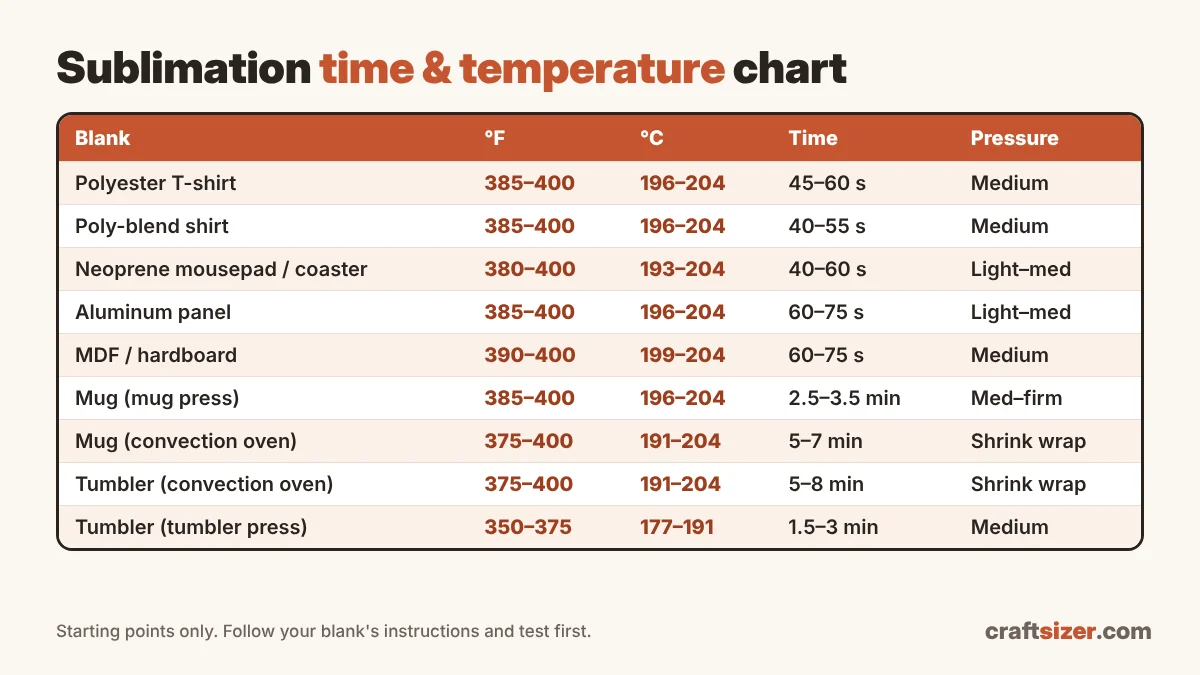
How to use this chart
Sublimation works by turning ink into a gas that bonds with polyester or a polymer coating. Three things control the result: temperature, time and pressure. Too little and the colors come out pale; too much and you get scorching, blurry edges or "ghosting." The ranges in this tool are common starting points used by crafters. They are not a replacement for the instructions that came with your blank, which are tuned to that specific coating.
Quick answer: the most common settings
- Polyester shirts, totes, pillow covers: 385–400 °F (196–204 °C), 45–60 seconds, medium pressure.
- Mugs in a mug press: 385–400 °F, about 2.5–3.5 minutes.
- Tumblers in a convection oven with shrink wrap: 375–400 °F, about 5–8 minutes.
- Hard flat blanks (MDF, aluminum): 385–400 °F, about 60–75 seconds.
- Ceramic tile, slate, sandstone: much longer, often 3–8 minutes. Follow the supplier's sheet.
Full sublimation time and temperature chart
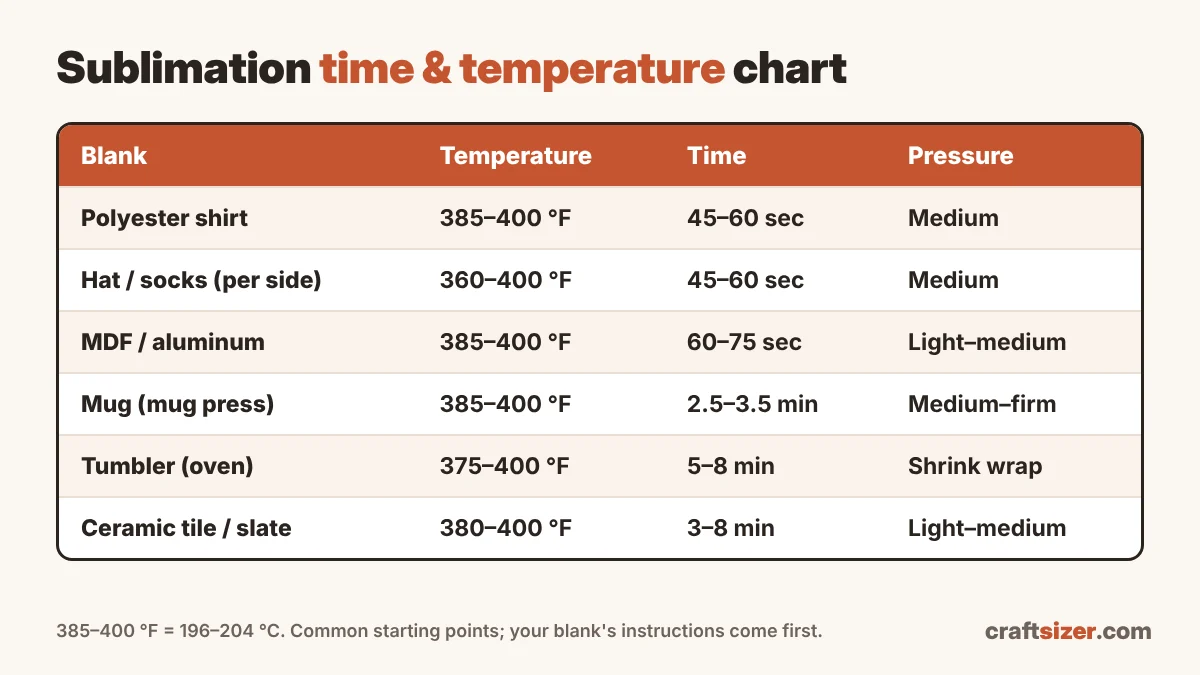
| Blank | Temperature | Time | Pressure | Equipment |
|---|---|---|---|---|
| Polyester T-shirt (100%) | 385–400 °F 196–204 °C | 45–60 sec | Medium | Heat press |
| Poly-blend shirt (50–65% polyester) | 385–400 °F 196–204 °C | 40–55 sec | Medium | Heat press |
| Polyester hoodie | 385 °F 196 °C | 55–60 sec | Medium | Heat press |
| Polyester pillow cover / tote | 385–400 °F 196–204 °C | 45–60 sec | Medium | Heat press |
| Polyester hat / cap (front panel) | 385–400 °F 196–204 °C | 45–55 sec | Medium | Heat press or hat press |
| Polyester socks | 360–385 °F 182–196 °C | 45–60 sec | Medium | Heat press |
| Sublimation-ready faux leather | 350–385 °F 177–196 °C | 40–60 sec | Light–medium | Heat press |
| Neoprene mousepad / coaster | 380–400 °F 193–204 °C | 40–60 sec | Light–medium | Heat press |
| Hardboard / MDF keychains, coasters & ornaments | 390–400 °F 199–204 °C | 60–75 sec | Medium | Heat press |
| Aluminum photo panel / sheet | 385–400 °F 196–204 °C | 60–75 sec | Light–medium | Heat press |
| Hard phone case insert (coated) | 400 °F 204 °C | 60–70 sec | Medium–firm | Heat press |
| Ceramic coaster | 385–400 °F 196–204 °C | 3–5 min | Medium | Heat press |
| Ceramic tile | 385–400 °F 196–204 °C | 6–8 min | Light–medium | Heat press |
| Sandstone coaster / car coaster | 390–400 °F 199–204 °C | 4.5–5.5 min | Light | Heat press |
| Slate photo blank | 380–400 °F 193–204 °C | 3–7 min | Light–medium | Heat press |
| Flat glass blank (photo panel, cutting board) | 375–400 °F 191–204 °C | 3–5 min | Light–medium | Heat press |
| 11 oz ceramic mug (mug press) | 385–400 °F 196–204 °C | 2.5–3.5 min | Medium–firm | Mug press |
| Ceramic mug (convection oven + shrink wrap) | 375–400 °F 191–204 °C | 5–7 min | Shrink wrap | Convection oven |
| Stainless steel tumbler (convection oven + shrink wrap) | 375–400 °F 191–204 °C | 5–8 min | Shrink wrap | Convection oven |
| Stainless steel tumbler (tumbler press) | 350–375 °F 177–191 °C | 90 sec – 3 min | Medium | Tumbler press |
| Glass can / frosted glass (convection oven) | 375–400 °F 191–204 °C | 5–7 min | Shrink wrap | Convection oven |
Common starting points used by crafters and blank suppliers. Your blank's own instructions come first, and settings for slate, glass and tile vary a lot by supplier.
How to dial in your settings
- Start in the middle of the suggested range.
- Test on one blank (or a scrap of the same material) before a batch.
- Colors pale or patchy? Add time in small steps (10 seconds for flat items, 30–60 seconds for oven items), or check that pressure is even.
- Brown/yellow tint or blurry edges? Reduce time or temperature slightly, and make sure the paper is taped so it can't move.
- Write it down. Every press and oven reads temperature a little differently. A cheap infrared thermometer helps you learn your machine's real temperature.
Heat press, mug press, oven or tumbler press?
- Flat heat press: for anything flat, from shirts to tiles. Short times, and pressure matters a lot.
- Mug press: wraps heat around a mug. Times are a few minutes, and every press reads a little differently.
- Convection oven with shrink wrap: handles mugs, tumblers and glass cans of any shape, including tapered ones, several at a time. Longer times. See shrink wrap vs tumbler press.
- Tumbler press: fast for straight tumblers, usually 1.5–3 minutes, but needs an attachment for tapered shapes.
What the result tells you
| You see | Most likely cause | Try |
|---|---|---|
| Pale or faded colors | Too little time, heat or pressure | Add 10 seconds (flat items) or 30–60 seconds (oven items) |
| Brown or yellow tint | Too much time or heat | Reduce time slightly; pre-press fabric to remove moisture |
| Blurry or doubled edges (ghosting) | Paper moved during or after pressing | Tape firmly and lift the paper in one smooth motion |
| Unprinted edges on tile or slate | Uneven or too little pressure | Use felt pads and center the blank under the press |
| Box marks on a shirt | Too much pressure, or the platen edge | Lower pressure or use a pressing pillow |
More fixes in sublimation problems and how to fix them.
Safety
- Never use an oven for sublimation that you also use for food.
- Work in a ventilated area, and use heat-resistant gloves for oven and tumbler work.
- Let blanks cool before handling; metal and hardboard stay hot much longer than fabric.
Frequently asked questions
What temperature do you sublimate a shirt at?
A common starting point for 100% polyester shirts is 385–400 °F for 45–60 seconds with medium pressure. Check your sublimation paper and shirt instructions, and test first.
How long do you sublimate a tumbler in a convection oven?
Many crafters start around 375–400 °F for about 5–8 minutes with shrink wrap. Ovens vary a lot, so test with one tumbler and adjust in small steps.
Why are my sublimation colors faded?
Usually the time or temperature is too low, the pressure is uneven, the blank isn't high-polyester or coated, or the print was made on the wrong side of the paper.
Can I sublimate on cotton?
Not directly. Sublimation ink bonds with polyester and special coatings. On cotton you need a sublimation-friendly HTV, a coating spray, or a different method.
How long do you press a sublimation mug in a mug press?
A common starting point for an 11 oz ceramic mug is 385–400 °F for about 2.5 to 3.5 minutes with medium to firm pressure. Mug presses vary a lot, so use your machine's preset if it has one and test one mug first.
What temperature is sublimation in Celsius?
Most polyester fabric is pressed at about 196–204 °C (385–400 °F) for 45–60 seconds. Hard blanks and mugs are usually in the same temperature range but need longer times.
How long do you sublimate a ceramic tile or slate?
Much longer than fabric: often 3 to 8 minutes at around 385–400 °F with light to medium pressure, face down on the transfer. Settings vary by supplier, so follow the instructions that came with your blank.
What temperature do you sublimate socks at?
Polyester socks are often pressed at about 360–385 °F for 45–60 seconds per side with medium pressure, using a sock insert and pressing one side at a time.
More free tools
Related articles
Last updated 2026-10-31. All calculations run in your browser. Nothing you enter or upload is sent to a server.