
Can You Sublimate on Cotton?
It's one of the first questions every new sublimation crafter asks, usually right after a cotton shirt comes out of the wash with a faded ghost of the design. The short answer is no, not directly. But there are good ways to get a full-color design onto cotton, and blends sit somewhere in between.
By the CraftSizer team · Updated 2026-11-10
Why sublimation needs polyester
Sublimation ink turns into a gas under heat and bonds with polyester fibers or a polymer coating. Cotton is a natural fiber with nothing for the ink to bond with, so the design sits on the surface and washes out, often after the first wash.
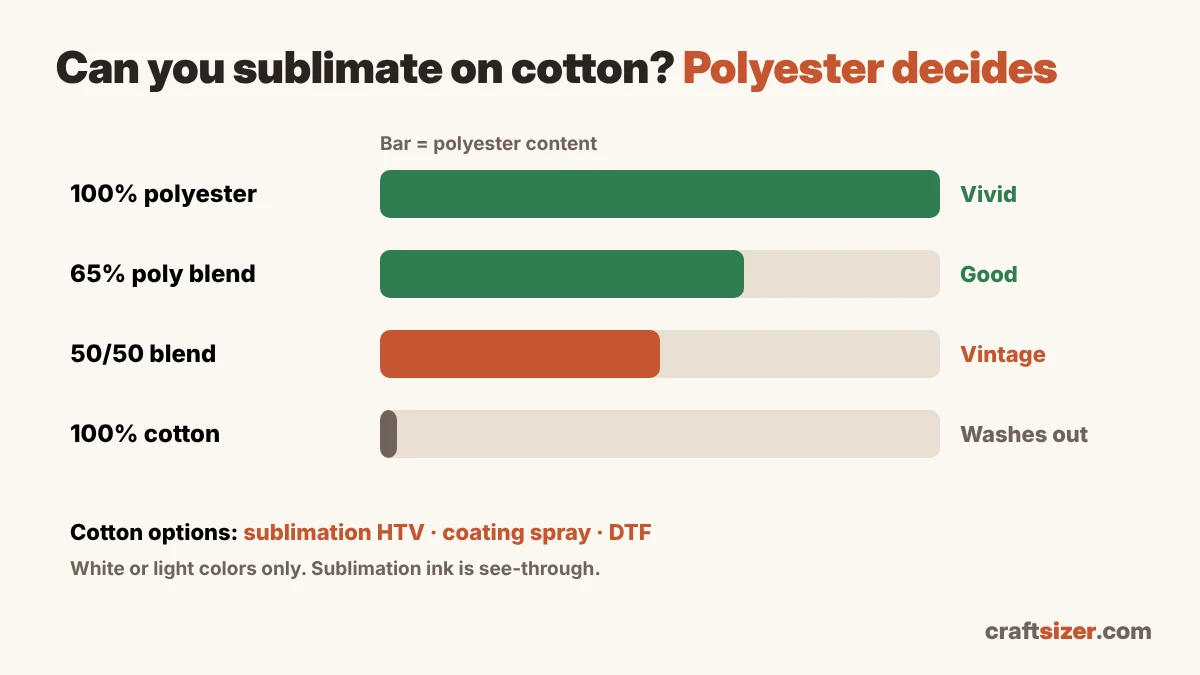
That's why the polyester content of a shirt matters more than anything else:
| Fabric | What to expect |
|---|---|
| 100% polyester | Bright, vivid colors that last. The best result. |
| 65% polyester or more | Good color, slightly softer than 100%. |
| 50/50 blend | A faded, "vintage" look, because only half the fibers take the ink. Some people love it. |
| Less than 50% polyester | Very faded, and fades more with washing. |
| 100% cotton | Washes out. Not suitable for direct sublimation. |
Sublimation also needs white or light-colored fabric. The ink is transparent, so it won't show on dark shirts, and white parts of a design print as the shirt color.
4 ways to put a full-color design on cotton
1. Sublimation HTV
White or glitter heat transfer vinyl made to take sublimation ink. You sublimate your design onto the vinyl, cut it out, and press the vinyl onto the cotton shirt. It works on dark shirts too, because the white vinyl gives the ink a light base. The vinyl has a slight feel on the fabric, like any HTV.
2. Sublimation coating spray
A polyester coating you spray onto the shirt, let dry and then sublimate over. Results vary a lot by brand, number of coats and washing, and the coated area can feel stiff. Test on a scrap shirt before selling anything.
3. DTF transfers
DTF prints are made for cotton, polyester and blends, in any color, on light or dark shirts, with nothing to weed. If you mostly make cotton shirts, DTF is often the simplest route. See DTF vs HTV and size your designs with the DTF transfer size chart.
4. Clear-film sublimation transfers
Some products let you sublimate onto a film that's then pressed onto cotton. They're newer and results depend heavily on the product, so follow the maker's instructions closely and test washing before you sell.
Getting the best result on polyester and blends
- Use the right settings. Most polyester fabric starts at about 385–400 °F for 45–60 seconds with medium pressure. See the sublimation time and temperature chart.
- Pre-press the shirt for a few seconds to remove moisture and wrinkles.
- Use a lint roller first. Fibers and lint leave white specks.
- Size the design right. Most adult front designs are 9–11 inches wide. The shirt design size calculator gives the height for your design's shape.
- Print sharp. Aim for about 300 pixels per inch at the final size. Check with the DPI checker.
If a print comes out faded, blurry or with ghosting, see sublimation problems and how to fix them.
Frequently asked questions
Can you sublimate on 100% cotton?
Not directly. Sublimation ink bonds with polyester, so on 100% cotton the design washes out. Use sublimation HTV, a sublimation coating spray or DTF transfers instead.
What percentage of polyester do you need for sublimation?
For bright, lasting colors, aim for 65% polyester or more, and 100% polyester for the most vivid result. A 50/50 blend gives a faded, vintage look.
Can you sublimate on a dark shirt?
Not directly, because sublimation ink is transparent. Sublimate onto white sublimation HTV and press that onto the dark shirt, or use DTF transfers.
What's the easiest way to print full color on cotton shirts?
DTF transfers are often the simplest: they work on cotton, polyester and blends in any color, with no weeding.