
DTF vs HTV: Which Is Better for Shirts?
HTV and DTF both end up as a design pressed onto a shirt, but they get there in very different ways. One is cut and weeded, the other is printed. Which is better depends mostly on your design and how many shirts you're making. Here's how they compare.
By the CraftSizer team · Updated 2026-11-08
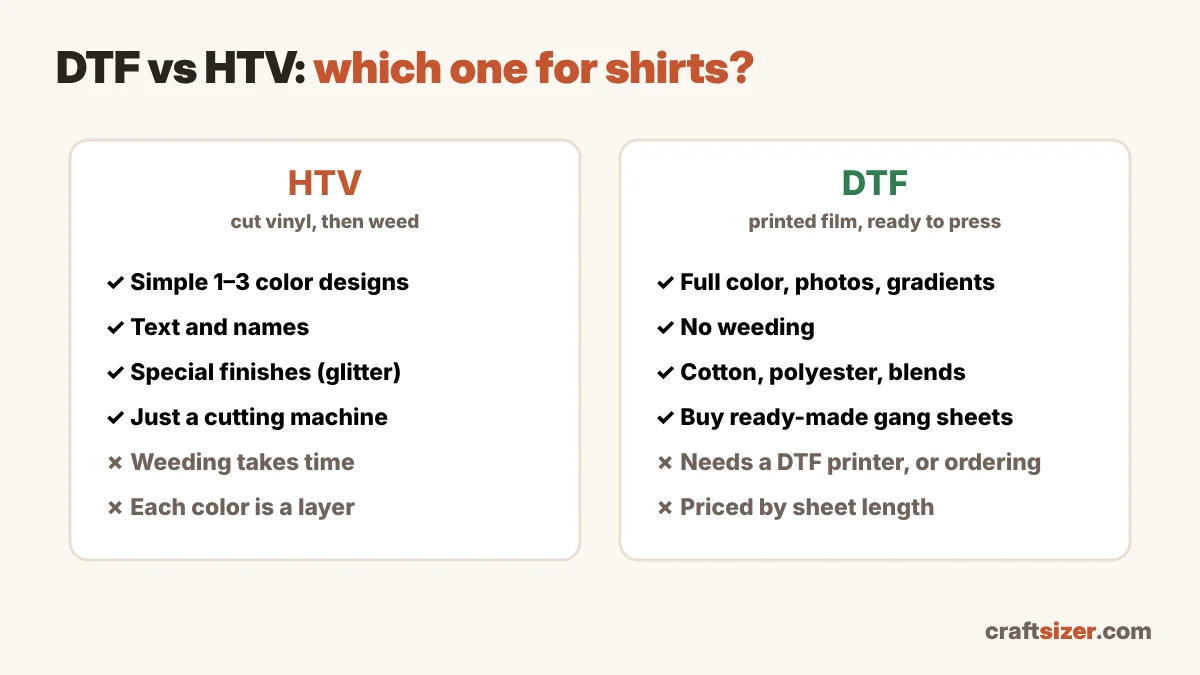
The quick difference
- HTV (heat transfer vinyl) is a sheet of colored vinyl. You cut the design on a machine like a Cricut, weed away the extra vinyl, and press it on. Each color is a separate layer.
- DTF (direct to film) is a design printed in full color onto a special film, with an adhesive powder on the back. You press it on and peel the film away. There's nothing to cut or weed.
Side by side
| HTV | DTF | |
|---|---|---|
| Best designs | Text, names, simple shapes, 1–3 colors | Full color, photos, gradients, fine detail |
| Equipment | Cutting machine and heat press or iron | DTF printer, or order ready-made transfers |
| Prep work | Cut, weed, layer each color | None after printing: press and peel |
| Fabrics | Depends on the vinyl type; many work on cotton and polyester | Cotton, polyester and blends |
| Special finishes | Glitter, metallic, holographic, puff | Mostly standard printed finish |
| How it's priced | By vinyl used, plus your weeding time | By gang sheet length (or printer costs) |
Always follow the press settings from your vinyl brand or transfer supplier. They vary between products.
When HTV is the better choice
- Names and numbers. Personalized team shirts or a name on a single shirt are quick to cut, and you don't pay for a whole transfer.
- One or two colors. Bold, simple designs look crisp in vinyl.
- Special effects. Glitter, metallic and holographic finishes are where HTV shines.
- You already have a cutting machine and only make a few shirts at a time.
When DTF is the better choice
- Full-color designs. Photos, watercolor art and gradients would take many vinyl layers, or simply aren't possible in HTV.
- Detailed designs. Thin lines and small pieces that would be painful to weed print easily.
- Batches. Order one gang sheet with many designs, cut them apart and press. No weeding time per shirt.
- Mixed fabrics. DTF works on cotton, polyester and blends, which is handy when customers choose their own shirts.
Sizing works the same way
Whichever you choose, the design size and placement don't change: an adult front is usually 9 to 11 inches wide, placed about 3 to 4 inches below the collar. Get the size for any shirt and placement with the shirt design size calculator, which works for HTV and DTF. See the placement guide for where each design goes.
Working out the cost
For HTV, most of the cost is your time: cutting, weeding and layering, plus a little vinyl. For DTF, the cost depends on how efficiently you fill a gang sheet. Two 10-inch designs fit side by side on a 22-inch sheet, but two 11-inch designs don't, which nearly doubles the length you pay for. The DTF gang sheet calculator shows how many designs fit and the cost per design, and the craft pricing calculator turns that into a selling price.
So which should you use?
Many shops use both: HTV for names, simple text and special finishes, and DTF for full-color artwork and batches. If you're starting with a cutting machine, HTV costs nothing extra to try. If customers keep asking for photos or colorful art, ordering DTF transfers is an easy next step without buying a printer.
Frequently asked questions
Is DTF or HTV better for shirts?
It depends on the design. HTV is better for simple one to three color designs, text, names and special finishes like glitter. DTF is better for full-color designs, photos, gradients and fine detail, with no weeding.
Do you need to weed DTF transfers?
No. DTF transfers are printed with the design only, so you press them on and peel away the film. There's nothing to cut or weed.
Can DTF go on cotton?
Yes. DTF transfers work on cotton, polyester and blends, which is one of their main advantages.
Is HTV cheaper than DTF?
For a single simple design, HTV is often cheaper, since you only use a little vinyl. For full-color designs or batches, DTF can work out cheaper because there's no weeding time, especially when a gang sheet is filled efficiently.